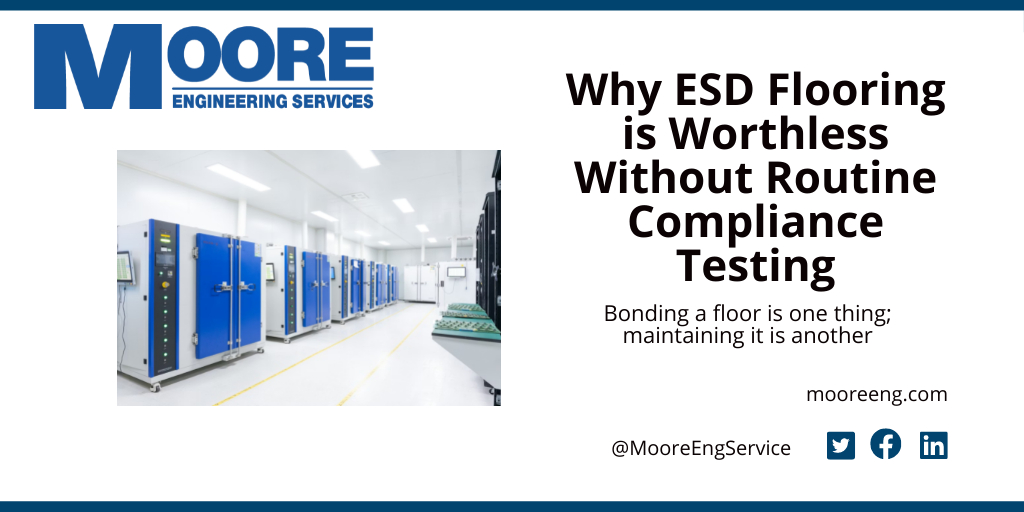
Facilities at an increased risk of ESD events, such as laboratories, clean rooms, hospitals, data centers, and manufacturing facilities all dealing with sensitive machinery, equipment, and materials need correctly bonded flooring, components, and personal equipment. Initial acceptance testing at the early stages of construction, including ASTM F150, ANSI/ESD S7.1, ANSI/ESD S20.20, and ANSI/ESD TR53, all inform the specific test methods and requirements for the intended location and use of the facility, but testing doesn’t stop at ensuring the floor is bonded correctly. To ensure long term functionality, compliance testing is a must.
Every construction project for the above-mentioned facilities require acceptance testing, as is the responsibility of every general contractor, project manager, and building owner to ensure this testing is done thoroughly for installation verification of the ESD specific flooring. Third-party inspectors conduct this testing with a background of ESD technical knowledge to troubleshoot and advise on next steps. Unfortunately, it is a common misconception that this is the only test needed, and what often isn’t realized is that if personnel are not grounding themselves through ESD specific footwear, wrist straps, mats, or other ESD control items, any work done in the facility risks an ESD event that will, overtime, likely disrupt the functionality of the machinery and equipment, or in extreme cases, cause painful static shocks or even explosions. Routinely scheduled compliance testing is a sure way to confirm that all grounding, equipment, and control devices continue to work effectively to avoid the hazards and risks with ESD sensitive environments.
Importance of Compliance Testing
While it is necessary to ensure all aspects of the facility are appropriately installed and bonded to the same common point, overtime those protections in place may be caused to fail through normal wear or misuse of equipment. For instance, a data center could have done the necessary work to install proper ESD flooring and bond all electronics correctly, but if personnel walk into the room without the required ESD protection they carry a static charge, and when they unplug or touch a device, that static charge is delivered into the device and causes a disruption. Overtime, this disruption will diminish the functionality of the device, which will likely become a continuous problem throughout the entire facility. Therefore, making all that time and money spent to initially maintain the facility in compliance with industry standards worthless.
What Are Control Items?
ESD control items, also referred to as ESD protective devices, work to maintain the ESD functionality in place by the bonded flooring. As stated in ANSI/ESD STM7.1-2020, “To effectively control electrostatic charge, flooring systems should be used in conjunction with ESD controlled footwear, foot grounders, seating (chairs), shelving, and mobile equipment (carts/trolleys), as appropriate.” When used correctly, these items and devices are bonded to the same point the flooring is bonded to. It is important that this bonding is verified through testing and that these devices remain bonded to ensure long term functionality.
Third party inspectors can work with the designated ESD control program manager to develop the compliance testing program necessary to maintain all ESD devices and systems. Compliance testing, while included as a requirement for an ESD Control Plan as outlined in ANSI/ESD S20.20-2021, is often overlooked. But a detailed compliance testing plan, which identifies the ESD control items to be tested routinely with the specific tests, is an imperative step after initial ESD acceptance testing.
What is the Risk of Electrostatic Discharge?
ESD flooring is used in buildings where great care needs to be paid to mitigating the risk of an ESD event. ANSI/ESD S7.1-2005 established test methods for measuring the electrical resistance of floor materials used for the control of electrostatic charge and discharge. Electrostatic discharge (ESD) is, “most commonly formed by the contact and separation of two materials. The materials may be similar or dissimilar; where dissimilar materials tend to generate higher levels of static charge” (ANSI/ESD TR20.20-2016). In essence, a static shock is charged and generated when two objects come in contact. We know this from times we walk on carpet and touch a light switch or door knob, but severity depends on the object and material. Industry test methods and procedures have been in development as early as the 1400s with early European and Caribbean forts using static control procedures and devices to prevent electrostatic discharge ignition of black powder stores. Similar risks occur today in modern facilities working with flammable chemicals and materials. While not every facility poses an extreme risk, improperly grounded ESD systems, or ESD systems that fail to maintain its protections through lack of routine testing, all present costly complications.
What’s Next?
After acceptance testing of any facility utilizing ESD bonded materials, the next step in routine maintenance must include proper implementation of ESD control items and compliance testing to ensure the initial set up of ESD bonded materials will not become null and void. Our lead technician is an ESDA certified TR53 technician qualified to assist in numerous testing needs per your facility type and travels nation-wide to conduct testing.
Please reach out to us through the contact form below or via phone at 856-437-7900 to discuss your ESD testing needs!









Leave A Comment